
A Bali ATV ride through rice fields sounds simple: a quad bike, green terraces and a camera-ready landscape. In practice, routes vary. Some pass beside cultivated paddies, others follow village lanes and plantation edges, while some combine rice-field views with muddy tracks, bamboo groves or jungle sections. The exact route depends on the operator, season, land access and current trail conditions.
This guide explains what “rice-field ATV riding” can realistically mean in Bali, how to assess a route before paying, what to expect and how to enjoy the scenery without treating working farmland as an amusement park. For background, see our guide to quad biking in Bali and how it differs from a regular ATV ride.
What a Bali ATV ride through rice fields actually involves
The phrase “ATV ride through rice fields” is used broadly in travel listings. It does not always mean riders drive directly between rows of rice plants. In many locations, the route runs along a designated dirt track, village access road, plantation path or the edge of a paddy, with rice terraces visible from parts of the trail.
That distinction matters. Rice paddies are working agricultural spaces, not motorsport circuits. Their narrow banks, irrigation channels and soft planting soil are not suitable for casual vehicle traffic. A responsible operator should use an established route with permission rather than send groups across planted plots or fragile field embankments.
Rice-field scenery versus riding inside a paddy
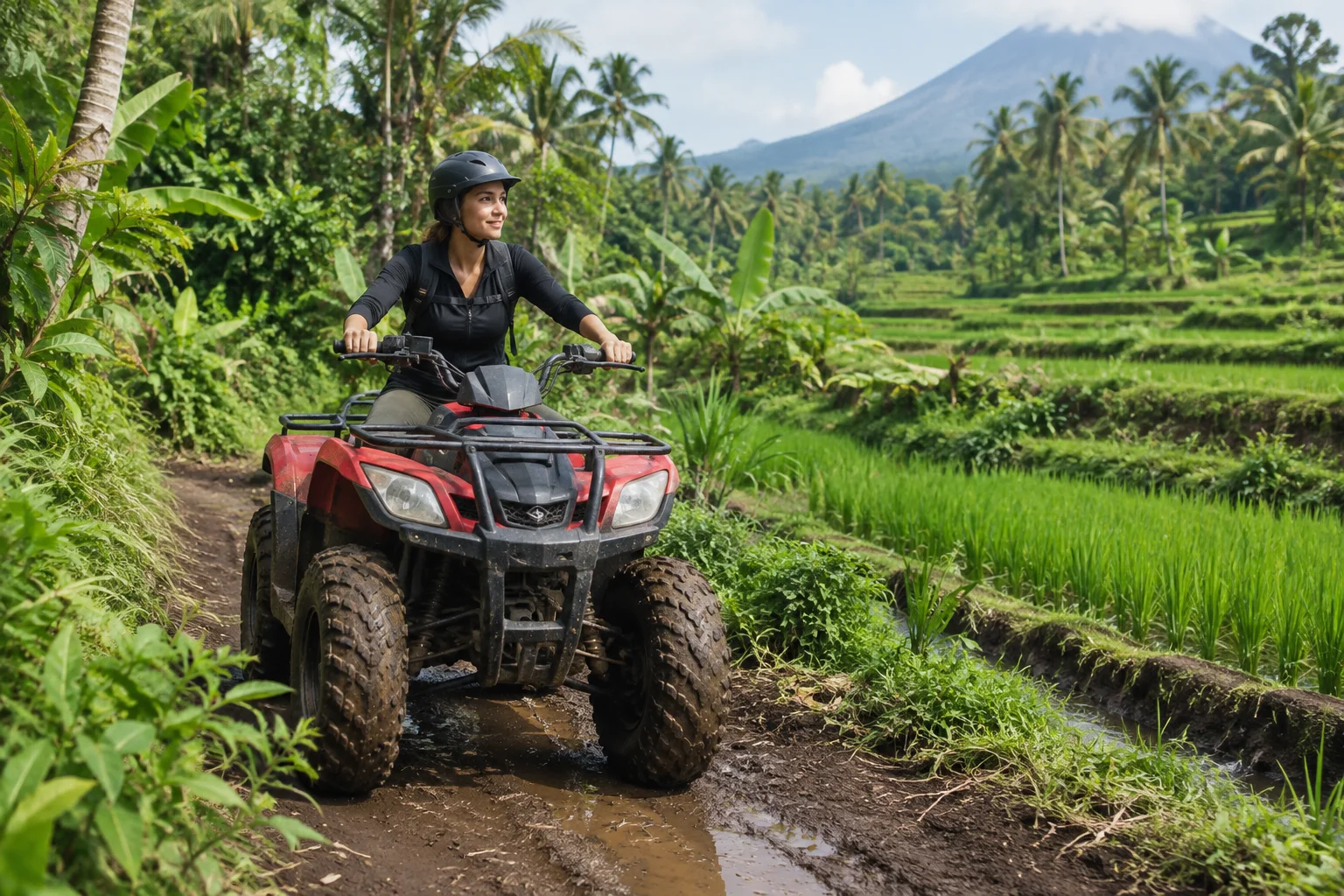
When you see a photo of an ATV beside bright green terraces, look for clues about the actual route. Is the vehicle on a defined trail? Are the rice plants beside the track rather than under the tyres? Does the operator explain where the route runs? These details help distinguish a scenic ride near farmland from a claim that may overstate what the activity includes.
Ask whether rice-field views are part of the standard route, whether the track is currently accessible and how much of the ride takes place in that landscape. Routes can change after heavy rain, maintenance or changes in local land access.
Why Bali’s rice-field landscape is special
Bali’s rice terraces are not simply decorative green hills. In many areas, rice cultivation is connected to the traditional subak irrigation system: a cooperative approach through which water is managed and shared among farming communities. The cultural landscape of Bali’s Subak System was inscribed on the UNESCO World Heritage List in 2012.
The system links water temples, farmers and the practical organisation of irrigation. It is a living agricultural and cultural landscape, not a theme park. Read the official overview on the UNESCO page for the Cultural Landscape of Bali Province.
For an ATV visitor, the takeaway is simple: the fields you admire may be part of someone’s livelihood and a carefully managed local system. Respect access boundaries, follow the guide’s instructions and never leave the authorised trail to get a closer photograph.
Rice terraces change with the farming calendar
The colour of the landscape is not fixed throughout the year. A paddy may be freshly planted and bright green, mature and golden, recently harvested, flooded before planting or temporarily resting. Rainfall, water availability and local planting schedules influence what you see.
A photograph from one month is not a guarantee of the same view on your travel date. If the scenery is a major reason for choosing a ride, ask for recent route photos rather than relying only on promotional images. Treat them as an indication, not a promise that every field will look identical.
How to choose a route with genuine rice-field views
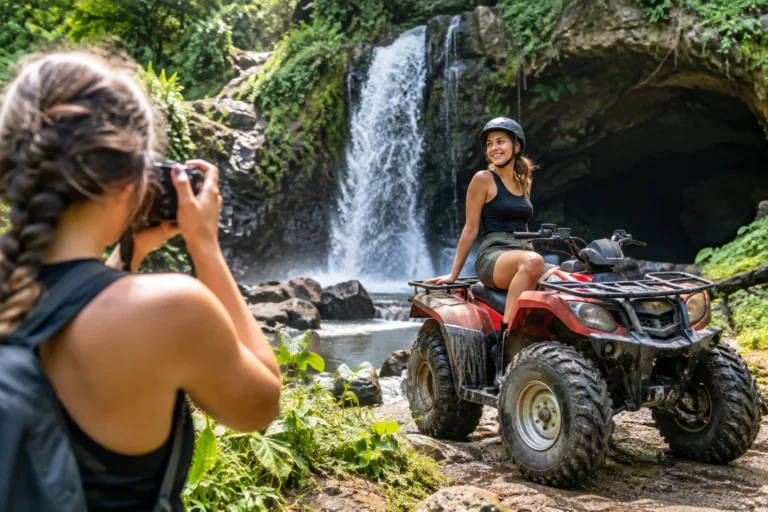
Not every Bali ATV route is designed around the same landscape. Some focus on jungle tracks, caves, river corridors, plantations or beaches. Rice-field scenery may be one section of a longer route rather than the whole experience.
Ask for the route description, not just the headline
Ask the operator to describe the main terrain in sequence: perhaps a village access track, plantation path, open paddy views, muddy section and return trail. The exact sequence varies, but a useful answer should be more specific than “beautiful rice fields and amazing nature.”
Ask whether the rice-field section is included in the normal ride or offered only on a particular package. Confirm that the route is currently operating and whether the scenery is viewed from a public or authorised trail. If the operator cannot explain the route clearly, compare another option before paying.
Check what is included in the activity time
Tour listings sometimes display total time at the venue, while actual riding duration is shorter. Registration, changing clothes, safety briefing, equipment fitting, group waiting and showering may all be part of the visit. Read our explanation of ATV riding time versus total activity time to plan transfers realistically.
Confirm whether the price includes a guide, helmet, boots or other protective equipment, insurance, locker, shower, towel, meal and hotel transfer. Inclusions differ between operators and packages; do not assume one listing’s details apply to another.
Look for recent route information
Ask when route photos or videos were taken. A trail may be rerouted for maintenance, weather, farming activity or safety reasons. Recent material is more useful than an attractive image with no date or location context.
Our overview of jungle, cave and beach ATV packages in Bali can also help you compare how terrain changes the character of a ride.
What the ride may look and feel like
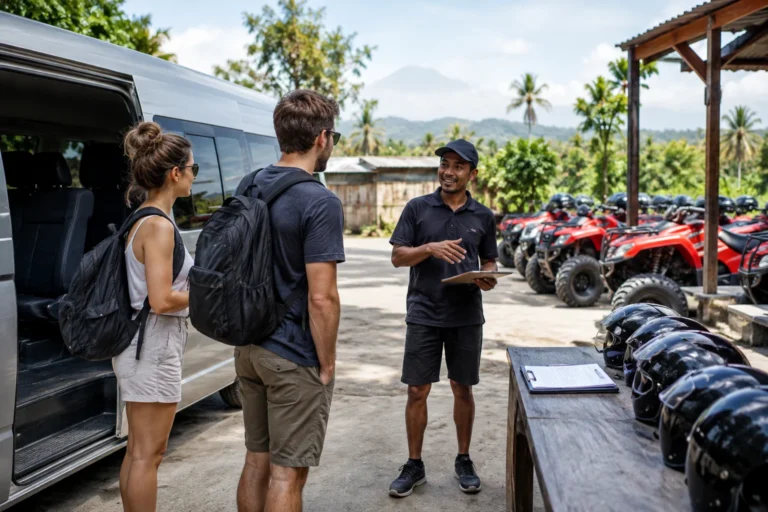
A guided ATV activity usually begins at the operator’s base. Staff check the booking, help with registration and provide equipment. A guide explains the controls, basic riding technique, hand signals and rules for keeping a safe distance. Some operators offer a short practice area before the group enters the main route.
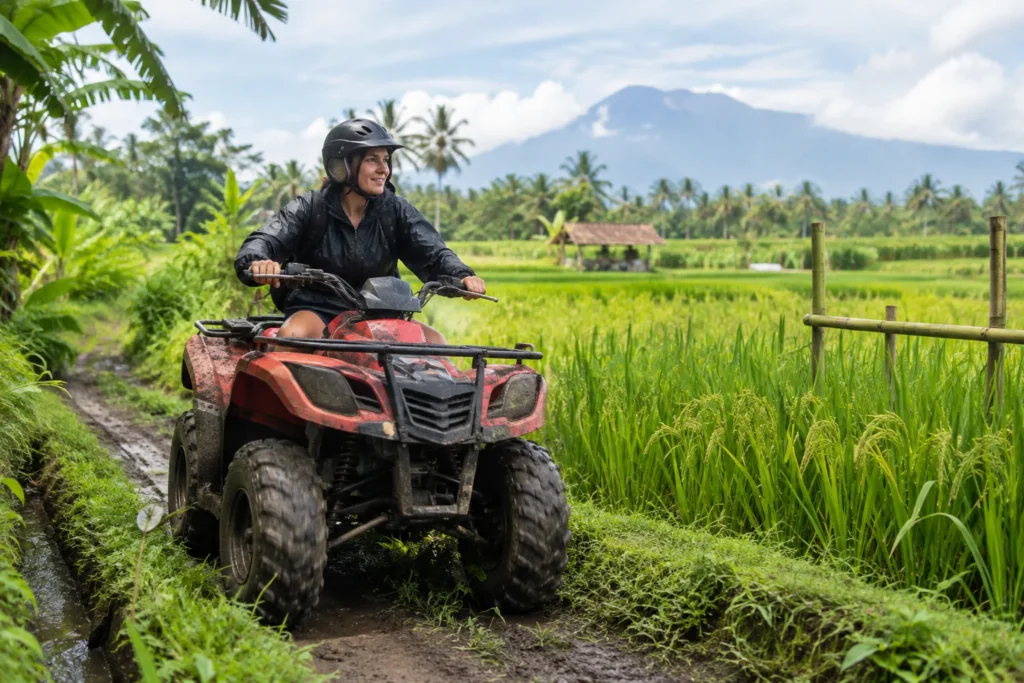
Once riding begins, the scenery may change several times. A route with rice-field views could also pass village surroundings, shaded plantations, open farmland or muddy sections. Packed earth can become slippery after rain, while loose gravel, ruts and narrow turns require steady control.
Do not expect a race
Guided tours are generally group activities. The guide sets the pace and may stop at designated points. The aim is to complete the route safely, not to overtake other riders or prove who has the fastest throttle hand.
Keep the distance requested by your guide. Avoid sudden acceleration, sharp turns and attempts to follow another rider’s line if you cannot see the surface clearly. If you feel uncomfortable, signal the guide and ask for help rather than trying to keep up.
Expect dust, mud and changing conditions
Dry tracks can be dusty; wet tracks can be muddy. The same route may feel different after a shower. Wear clothes that can get dirty, secure loose items and protect your phone. Use only approved stops for photographs. Never try to take a picture while steering through a difficult section.
Respecting farmers, villages and irrigation areas
The best way to enjoy a rural ATV route is to remember that it passes through a lived-in landscape. Farmers may be working, carrying tools, managing water or moving between fields. Residents may use narrow lanes for daily transport. A little consideration makes the experience better for everyone.
Stay on the authorised track
Do not ride onto planted areas, cross paddy banks or enter irrigation channels. Even a short detour can damage young plants, weaken an embankment or disturb water flow. If a guide tells the group to stop or wait, follow that instruction.
Keep noise and behaviour under control
ATVs are noisy machines. Avoid unnecessary revving near homes, temples, livestock or people working in the fields. Do not throw rubbish, leave cigarette ends or approach animals for photographs. If local residents are passing, give them space and follow the guide’s directions.
Ask before photographing people
A landscape photograph is different from a close-up portrait of a farmer at work. If a person is identifiable, ask permission before taking or sharing their photograph. Be considerate around ceremonies, private homes and places of worship.
Responsible tourism does not require a complicated checklist. Stay on the route, respect people’s space, listen to local guides and remember that the fields are productive land first and scenery second.
Safety considerations for a rice-field ATV route
Rice-field scenery can make a route look gentle, but the riding surface may still include slopes, slippery soil, drainage crossings, narrow turns and uneven ground. Do not judge difficulty from a landscape photo alone.
Tell the operator about your experience
Be honest about whether you have ridden an ATV before. A beginner may need a slower introduction and more guidance. Ask whether there is a practice area and whether the guide can adjust the pace. If you are unsure about a section, stop in a safe place and ask for assistance.
Use the equipment provided
Wear the helmet correctly and use protective equipment supplied or required by the operator. Check that the helmet fits and straps are secured. Wear closed footwear if required, and avoid loose clothing that could catch on controls or moving parts.
Follow the safety briefing even if you have ridden elsewhere. Controls, vehicle types, track layouts and local procedures differ. The ATV Safety Institute’s ATV riding tips provide general guidance, but your guide’s instructions for the specific vehicle and route take priority.
Know when to slow down or stop
Reduce speed before turns, slopes and unfamiliar surfaces. Do not attempt a manoeuvre beyond your ability. Keep both hands where instructed, look ahead and leave room between vehicles. Never ride under the influence of alcohol or drugs, and do not use a phone while moving.
For broader preparation, see our guide to ATV check-in, equipment and safety briefings in Bali.
When is a good time to ride near Bali’s rice fields?
There is no single perfect month for every route. The appearance of paddies depends on local planting and harvesting cycles, while trail conditions depend on recent weather and maintenance. A green landscape may be more likely during active growing periods, but exact timing varies by village and irrigation schedule.
Morning rides can feel cooler than the middle of the day, although temperature and trail conditions change. Afternoon rides may offer different light, but rain can affect visibility and grip. Rather than relying on a universal “best season,” ask the operator about the current condition of the specific route.
During or after heavy rain, some trails may become slippery or temporarily unavailable. Operators may change the route for safety. Read what to know about an ATV ride in Bali after heavy rain before deciding whether to keep a booking during unsettled weather.
Who is this kind of ATV experience suitable for?
A route with open scenery and rice-field views may appeal to travellers who want more than a fast ride. It can suit couples, friends and visitors who enjoy rural landscapes as part of an outdoor activity. Suitability still depends on the operator’s age, height, health and passenger rules, as well as the rider’s comfort with the vehicle and terrain.
Do not assume a scenic route is automatically suitable for every child or inexperienced participant. Check minimum age requirements, whether children may ride as passengers, and whether a tandem option is available. Ask about medical or mobility restrictions directly with the operator.
If you are travelling as a pair, our guide to single versus tandem ATV rides for couples explains practical differences to consider.
Questions to ask before you book
- Does the current route include rice-field views, or is it mainly jungle, plantation or another terrain?
- Are riders using a designated track beside the paddies rather than driving across planted fields?
- How long is the actual riding time, separate from check-in and shower time?
- What safety equipment, guide support and insurance are included?
- Are single and tandem vehicles available, and what are the age and passenger rules?
- What happens if heavy rain makes the route unsafe or unavailable?
- Are hotel transfers included, and which areas are covered?
- Can the operator share recent photos or videos of the route currently in use?
Clear answers help you compare packages on more than price. If you are ready to explore options, visit the Bali ATV booking page and confirm the current route, inclusions and schedule before finalising your plans.
How to prepare for the day
Wear comfortable clothes that you do not mind getting dusty or muddy. Choose secure footwear, bring a change of clothes and keep valuables to a minimum. A small waterproof pouch can protect your phone, but leave photography to designated stops. If the operator supplies lockers, ask how they work before the ride begins.
Eat something light beforehand and drink water. Follow the operator’s advice about food, hydration and any health restrictions. Arrive with enough time for registration and the briefing rather than expecting to jump straight onto a vehicle.
After the ride, use the shower and changing facilities if included. Check your belongings before leaving and allow enough transfer time if you have another activity planned. Mud has a talent for making a quick stop slightly less quick.
Frequently asked questions
Can you really ride an ATV through rice fields in Bali?
Some routes include rice-field scenery, but this does not necessarily mean vehicles drive through planted paddies. Many responsible routes use designated tracks beside or near the fields. Confirm the exact route with the operator before booking.
Which area in Bali has the best rice-field ATV route?
There is no single best route for every traveller. Availability and scenery depend on the operator and current land access. Compare recent route photos, terrain descriptions, safety arrangements and inclusions rather than choosing by a location name alone.
Are rice-field ATV rides suitable for beginners?
Some guided tours accept beginners and provide a briefing or practice session. Difficulty still depends on the surface, slopes and weather. Tell the operator that you are new to ATV riding and ask whether the route and pace are suitable.
Will the rice fields be green all year?
No. Rice paddies change through planting, growing, harvesting and preparation periods. The landscape may be green, golden, flooded or recently harvested depending on local farming schedules. Ask for recent photos if the view is important to you.
Can I stop to take photos during the ride?
Only stop at locations approved by your guide. Do not take photos while moving or leave the authorised trail to reach a viewpoint. Ask permission before photographing farmers or residents at close range.
What should I wear for a rice-field ATV ride?
Wear comfortable clothes that can get dirty, secure footwear and any protective equipment required by the operator. Bring a change of clothes and protect your phone and valuables from mud and water.
Does rain cancel a rice-field ATV tour?
Not automatically. Light rain may be manageable on some routes, while heavy rain can make surfaces unsafe or cause route changes. The operator should make the final decision based on current conditions. Confirm the cancellation, rescheduling or refund policy before paying.
How do I choose a responsible ATV operator?
Look for clear route information, a proper safety briefing, suitable equipment, trained guides and respect for farmland and village access. Ask how the operator prevents riders from entering planted areas and what happens if the trail becomes unsafe.
Enjoy the landscape, not just the ride
A Bali ATV experience with rice-field views can be a memorable way to see a different side of the island. The best choice is not necessarily the route with the boldest promotional photograph. It is the one that explains what you will actually ride, provides appropriate guidance and treats the surrounding landscape with care.
Ask specific questions, check recent route conditions and follow your guide’s instructions. That way, you can enjoy the contrast of open paddies, rural tracks and greener corners of Bali while helping keep the experience respectful for the communities who live and work there.
To compare current options and plan your activity, visit Bali Quad ATV Ride and review the details before booking.